I had the good fortune to grow up in the midst of those who were “elder.”
I was an only child with a mother who was both indifferent and terrified of being a mother, and she needed all the help she could get. Two grandmothers, one from each side of the family, moved in to see what they could do to provide support and comfort for this young girl with the cherubic face, strawberry blond curls, and bright blue eyes. They helped pay for my wardrobe, provided their beautiful houses where I could come and be treated royally, showered me with presents on all the right occasions, taught me some etiquette, and ultimately paid for my private school education.
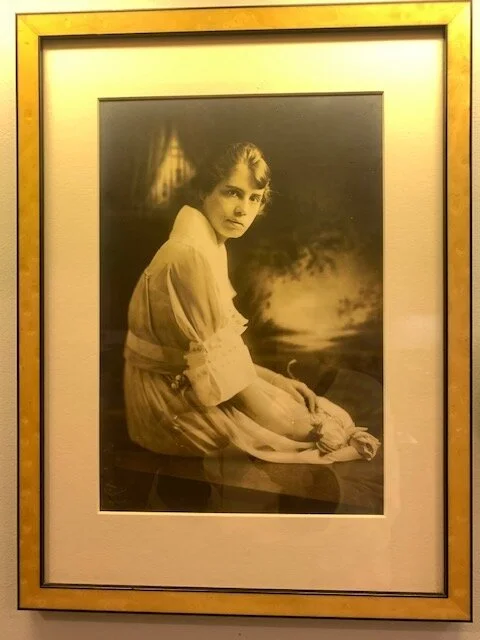
They were grand ladies, Ellen and Lavinia … Ellen was from Irish stock in New Jersey, well monied, and she had the most beautiful heart shaped faced and deep brown eyes. She married two men, one who was a ne’er-do-well with no vision of success, and the other a publishing magnate. She was a woman who seemed to be blessed with good fortune, materially that is. She had two sets of children, my mother and her sister Pucky from the charming neer-do- well, and a sister and brother from the the publishing giant. Her children were tended by a succession of governesses. What did I learn in her house on Long Island? That cocktail hour always preceded lunch and dinner, that children at the table needed to “be seen and not heard,” that summer thunderstorms on Long Island were ferocious, that all the women in the family seemed to smoke cigarettes, and that the Christmas tree in winter was the grandest, most sparkling and fragrant tree ever. As a child I wandered through what we called the “big house” and often ended up in the kitchen to see what the cook was working on, I watched my grandmother play bridge with her lady friends, sometimes I played croquet with my handsome uncle Nelson, and I pretty much stayed in my own little lonely bubble.
Lavinia was an elder of a different sort altogether. She had been raised by a doting father in Charleston, South Carolina, in the absence of a mother who died when she was a baby, and she managed to raise two sons in the traditional and formal East Coast way - my authoritarian grandfather dispensing the discipline and my grandmother tending to the needs of the household. She and my grandfather moved from the East Coast to San Francisco, and she looked forward to welcoming our family into her lovely house. She was longing for familial love again, and I was her perfect subject. Her glorious grey house on a steep San Francisco hill was home to beautiful French antiques, formal family portraits, gold Japanese screens, and a baby grand piano; from the age of about seven, I grew up in this house and came to find my place as an adored child, a far cry from my time with my New York grandmother. Grandmother Dimond taught me table manners, lovingkindness, dominos, classical music, the joys of travel and adventure (she had always been an adventurer), and reading together at night before falling off to sleep to the sound of moaning foghorns. I was the daughter she never had, and she loved me with all her heart. I think it’s safe to say that my eventual reverence for the elders of the world was a result of spending all those young years in her company.
I grew up with a feeling of familiarity with the old people, those ladies who formed my grandmother’s social circle, didn’t see them as separate from myself; I found them all pretty interesting, wispy gray hair and all.
To this day I have warm memories of sitting around her dark Chinese coffee table listening to their stories of family, the various and sundry ailments, their social and political concerns, even their complaints about retired husbands!
I am an elder myself now and I spend a lot of time considering just what it all means. What place do I have in the larger world? It helps me to look back on these grandmothers to begin to understand it all. It would seem that elders have the luxury of pontificating, teaching, guiding, and indulging their own whims. They have a certain command of people’s attention — just like my grandmother Dimond always did - because of their stature as elders. I see that now when I gather my grandchildren around the table for a meal and nudge them to listen to what I think is an important story containing some profound human truth, like impermanence for instance. Do their eyes glaze over? Sometimes. But do they take this wisdom with them? That is the important question. Which gets me to perhaps the most obvious characteristic of elder hood: wisdom. If one has lived seventy years or more one has undoubtedly amassed a significant amount of insight and experience, and thus has perhaps some important, maybe profound (?) things to say. The key is when to say it and how. When I came upon the Buddha’s teaching about Right Speech in my fifties — speaking what is true, timely, and kind — I found a new way to impart wisdom, to get my family to listen to me. When I’m filled the urge to let the grandchildren know something important, I take a pause often to see if it is “timely,” and my intention is positive … so there’s a chance they’ll actually hear what I have to say. I have always been a word person, I love words dearly, and of course love casting them about. But we must be careful with words, for they are powerful things when we have a captive audience … and there’s a time and place for everything, right?
Being an elder has its more shadowy side, too.
I’m thinking of invisibility and frailty. We live in the 21st century in America and our elders are often marginalized and forgotten in favor of youth with all its trappings: electronic gadgets, fit bits, state of the art diets, and metaphysical self-help gurus. This is hard. I walk the city streets feeling somewhat invisible, as I did when I was a child around my mother, and I wonder if my grandmother Dimond or Doubleday ever felt they moved in the shadows as elder women. And did they ever become consumed by the seemingly never-ending physical frailties that take over their old bodies? Looking back, it doesn’t seem so to me. They seemed so dominant, self possessed, and assured of their position. When grandmother Dimond went blind from macular degeneration in her eighties, I saw great anger flare in her briefly as she began to adjust to a sightless, confined life, but then it soon passed, and she moved gracefully into that dark world with all the good will she could muster. Grandmother Ellen had hip problems and a chronic smoker’s cough, but she didn’t seem to let these things get in her way…. at least for a while. These two women didn’t lead what I would call “exterior” lives the way I now do. They weren’t out on the street a lot, walking the dog, going to restaurants, getting on airplanes and trains, observing all the while how they were being causally and consistently overlooked. They had their glorious homes, complete with housekeepers who tended to their needs, and their landscape didn’t expand very much as they aged and their bodies slowed down. Or maybe they saw the limitations of their old age and chose not to admit it to anyone. After all, they both came from a time when women were trained to keep their mouths shut and bear their burdens politely and quietly.
I just lost an elder in my life last week: my aunt Pucky, my mother’s ornery, brilliant sister who had the tenacity and stubbornness to survive until the age of 94. The product of great wealth and privilege, she had a difficult and lonely life. She was an alcoholic who gave up drinking at a young age, a clever writer trying like crazy to make a go of theater writing in New York, and the least beautiful daughter of the matriarch Ellen McCarter. Her success was limited though she was surrounded by brilliant creative artists all of her adult life. She never seemed to make a go of relationships with men, and as she grew into middle age she created a loving partnership with a woman artist who then shared those elder years with her. She was mean spirited and funny, and she had a huge influence on me despite our prickly relationship. She turned her back on my mother when she was desperately sick with alcoholism and I had a hard time forgiving her for that … but of course, of course, I did. What my aunt Pucky taught me through her life and her words was that the path of a writer was a worthy, exciting, and compelling thing, and that if one had the talent — and she always thought that I did - one had the responsibility to forge ahead and do the work, speak the truth to the world. She didn’t always speak the truth the way she would have liked, but she admired those who did. She once told me I had “emotional honesty,” that I had the guts to speak what was real, and that meant everything to me. I kept those words of hers close to my heart and they fed me as I struggled to complete Bowing to Elephant about five years ago. I was proud to be able to share my book with her just a year ago on a New York visit; she and I sat for hours in her lovely bright apartment and shared stories of family, writing, the state of the world, and we celebrated the resurrection of our relationship.
I’m approaching another milestone of sorts: 75. Why is that a milestone? I think of 1775 and the birth of our fragile democracy… I think of 3/4 of a century …. Milestone or no, it is an achievement, as was the ninety-four years that my aunt journeyed through her life. Achievement, yes! That’s another trait of elderhood, isn’t it?
By virtue of the years of inhabiting our imperfect bodies and meeting life’s challenges, we achieve certain things; wisdom, crankiness, humor, deep understanding of impermanence, oneness with all, heartfelt care for others, more crankiness, melancholy, and then perhaps more laughter and humor.
You must have humor, aunt Pucky always said…. You might as well have humor, I say, because as a wise character (played by Lionel Barrymore) said in an upliftingFrank Capra comedy from the 30’s, “you can’t take it with you!”