Why I Love Voting

When you drop your ballot in the box at your polling place or in your mailbox, what arises - at least for me - is the sense that all is not lost. Not yet. Not now. You are joining many millions of your fellow citizens in making your decisions known, you are participating in this challenging experiment called democracy. What I want to say is: you are doing something good, not only for yourself and your sense of civic pride, but you are doing something for your fellow beings in this country as you affirm that we are a body of humans who share commonly held values: health care, economic justice, educational opportunity, women’s rights, preserving the environment, the curtailing of violence and death… just to name a few. Whether you belong to the herd of the elephant (GOP) or that of the donkey (DEM), you share deeply held aspirations with your fellow Americans, and an overarching vision to actually hold hope, and to imagine the betterment of our society.

When we vote, we are saying the following:

-I continue to hope for the best we can do for one another

-I continue to acknowledge that this country is a participatory adventure

-I feel gratitude for living in a country where we actually have the right to vote

-In doing this, I continue to manifest in the world my own deepest values

All good stuff, right? Not particularly complicated when you think about it. And the best part of this act is that it makes you feel really good about your place in the world, it brings a smile to your face perhaps. Or at least it did for me… I am tired of being a cynic and a snarling critic of the extreme right, though they give me ample reasons to respond. It’s hard to imagine NOT responding to the destruction of our environment, the withdrawing of care of our poorest most vulnerable citizens, to the denigrating of women and all minorities for that matter. But in that moment where I let go of my ballot I wasn’t thinking in those terms. Rather I felt free of rancor for a brief and lucid moment, sort of the way I become free of raging feelings when I meditate or play the piano, or walk on the beach. To be free in this way is definitely good for our mental health, right?

Because I’m a Buddhist practitioner, I know that this idyllic sense of ok-ness won’t last forever, and that the dark clouds of division and anger and ignorance will return to cast their shadows. And then again we’ll have to figure out how to hold all the chaos and the pain. But for now, as I devour my lunchtime artichoke, I will relish this feeling of an even tempered heart, a sense that as I voted I joined a massive long lineage of brave people who fought, struggled, demonstrated, and just plain waited in line forever, for the RIGHT TO VOTE.

When we wake up tomorrow morning amidst the likely uncertainty and angst about that uncertainty, let’s remember that the cycles of human history show us a continuing river of change. Things don’t go up unless they’ve gone down, and so on… And as long as we choose to take part in the participatory experiment, we can be assured that change will be upon us, and that we will be a part of that change.

With immense gratitude to all who rose up and voiced their will today, and for those who didn’t, well there’s always 2020!
Mag Dimond
Why We Need the Movies

It has been a long time since I offered anything up here, and I confess that I have no logical reason for that. All I know is that in the last month my mind and heart have been consumed by the chaos of our society at large, I’ve felt awash in acrimony, hatred, and despair for the cruelty which shows up all around us almost every day. It is hard to write from the most authentic soulful place when that place feels injured and enraged.

Last Saturday I went to the movies with a new friend, to a picture I felt would surely satisfy my desire to “escape” from the reality of 2018 politics. And I was right. “A Star is Born” — the fourth iteration of a classic tragic love story was just the right escapism choice. This raw and emotion laden movie sweeps you up and carries you along on a journey filled with both the pulsing joy and exhilaration of love and the inevitable downward spiral into failure — both of character and of that idealism that tells us love is perfect and everlasting. The chemistry of new love in the film is heady and it makes your body feel energized and happy as you sit there in the dark nibbling on your popcorn. Bradley Cooper and Lady Gaga inhabit these roles perfectly, as though they were replaying them from a former true experience. But as with every great melodrama, there is the fatal flaw, the chink in the armor that spells doom: in this instance it’s alcoholism and its cruel consequences. This disease prevents those who are sick from giving real love to another. I grew up surrounded by this sickness, and I know. And so the fulfilling, heart-thumping movie descends into tragedy, slowly and inexorably, as a sweet golden dog sits outside the garage door one night.

I loved this movie because it felt like I was experiencing the life of real human beings. I thought not only about my own sad experiences growing up, about the hundreds I’ve read about, the many that I’ve known along the way, who became crippled by addiction and forgot that love was the most important force in our human lives. An expensive Hollywood melodrama can offer you this slice of real life when they treat the story with deep respect. Cooper did that, and he produced a deeply touching film.

Meanwhile, outside the movie house there is another kind of movie unfolding, and it doesn’t last for a mere two hours. It is ongoing. It is also surreal … the kind of experience that makes you feel dizzy and exhausted. It looks like this: a Supreme Court nominee with a sketchy personal past rides to confirmation with the help of an antiquated community of Republican senators hell bent on doing their presidents’ bidding, children from South and Central America are still being held in detention without much hope of connecting with family, women are being either ignored or mocked for coming forth and telling intimate and painful stories, money still lies primarily in the hands of the wealthy, black people are being assassinated in large numbers on city streets by untrained, racist police, and they get little justice, minority voters in many states are being denied, and fear and hatred seem to rule the day… Sound like a disorganized horror film? You bet. And guess what, it goes on and on and on… too many people seem immune to responding to injustice - or are they just plain exhausted? This movie that is unfolding in front of us has a terrible script in which the same dark, dishonest, corrupted behavior occurs while an investigation into obstruction of justice quietly grinds on in the distance. All this has become something resembling an epic narrative because of social media and the like. There is a never-ending spooling out of narratives from the political world, both domestic and international, and it it is virtually impossible not to witness it, unless one were to flee into monastic retreat far away to sit in silence and find peace. This is the movie none of us chooses to watch. But there it is.

I grew up a romantic like my mother. I wanted to read and watch love stories, great historical sagas where human nature was shown for its magnificent and flawed qualities and in the end resolution inevitably emerged. All dramas have an ending, don’t they? Think of War and Peace, Grapes of Wrath, Great Expectations, Pride and Prejudice, Hamlet, Macbeth, and To Kill a Mockingbird, just for starters. All these generous and heartfelt works of art finally reach their conclusion, and the audience sees how the flawed and dark qualities of mankind create serious consequences. The same is true of the great film dramas like Casablanca, An Affair to Remember, High Noon, and City Lights. We traverse the great arc of love and tragedy and we arrive at a settled, sometimes satisfied place.

Today we wake up day after day and this film of our political circumstance rolls on. The narrative through line is not clear, and that causes us to be afraid and anxious. Where this dark film we’re living through will take us we don’t know, but we do know that the journey depletes our spirit and makes us want to rush off in search of some kind of beautiful escape, if only for a few hours, like the marvelous “A Star is Born.” I urge all of you who share some of what I feel to find a movie that beckons you, and take yourself there with a friend (or without) to sit in the dark with your bag of popcorn, and to feel at one with our real human story, if only for a brief moment.

Mag Dimond
On Not Knowing Where it's Going to Take You ...

When I began my memoir about 4 years ago, I had no idea where my ideas would take me… All I knew was that I had to tell a story and get it into book form. My first instinct was to write a series of travel essays that would tell the world what my eclectic and cultured life looked like. Before too long, I realized I had to allow members of my family, people who had populated my childhood and so on, to make an appearance. It seemed that they were asking for it. What was really happening was that as I looked clearly and carefully at what I loved and valued in my current life, travel being the most significant, I saw that it all came about because of the accumulated causes and conditions of my 70 year old life, which meant that my family and my past played a big part. And so it evolved… Chapters became little mosaics of present and past experience as I tried to communicate just WHY I found myself in Bhutan, or Paris, or Vietnam… Such an adventure that was - and is.

I have been thinking a lot these days about women and sexual harassment. In particular I have become distressed that our male dominated culture trivializes the oppression of women, even though we have a number of grand examples of powerhouse women out there in the public sphere. We have been a patriarchal society since the days of the Founding Fathers, after all. Right now there is a smug, ruddy-faced man being considered for the Supreme Court who is accused of attempted rape in his high school days. And yes, he is smug - and smart. And yes, we do not know right now what his story he might tell about this particular occurrence. What we do know is that he has been less than open and generous with his responses so far, and occasionally has lied under oath. A young woman has been gutsy enough to come forward and share an excruciating memory from her past, to tell the honest truth about it, and for that she is being handled in what I would call a less than respectful and compassionate way. I have learned that anyone’s experience of past trauma becomes an indelible memory in the psyche. You don’t forget these things though you may forget where and exactly when they happened. I believe this.

Why do I believe it? Because I experienced trauma - not of this sort, but trauma nevertheless, and my memories of being abandoned by my mother at age 7 or 8 are deeply and vividly engraved into my consciousness. As I have come to understand the ramifications of trauma, my heart has opened wide to embrace those who have suffered deeply as children. The children separated from parents at our border recently are some recent examples of serious trauma; they will never escape from that sense of abandonment and cruelty for the rest of their lives.

What does all this make me think of? I am remembering living in Taos, New Mexico in the late 90’s, a time where women were routinely brutally abused by men, sometimes left to rot on mountain hillsides after being raped and stabbed. Taos is a small town, it was born out of the Latino culture, one in which women were often treated like possessions. Taos is also one of the poorest communities in the United States, where young people drink themselves into oblivion because of their feeling of hopelessness, and where property owners randomly shoot and kill domestic animals for sport. The judicial system in this town was controlled by such men, as was the police force, so there was little opportunity for justice to be done in the case of these brutal events. I lived and worked there for over 12 years, and because it was a small town, and because I was a woman, I felt hugely vulnerable. I didn’t know how to relate to men I ran into at the gas station or the hardware store or at the local tavern. I told my partner how I felt about it, and he responded that it wasn’t as big a deal as I thought it was. BUT, he was a man. Of course. On the one hand, I loved this community for its artistic heritage, openness, Indian culture, and its magnificent physical beauty, but in the end I needed to leave because I felt I was not safe there.

Women need to think of safety. And so do men. But for women there is a disadvantage: the cards are stacked against us still, all these year after women’s rights have enabled improvements across the social spectrum. Dr. Ford, the woman who claimed that Judge Kavanaugh assaulted her in high school, is taking a courageous step which puts her at serious risk — risk of condemnation and ridicule by portions of our society, and risk of hatred coming her way for being the brave person she is. Having revealed her dark story, she can no longer retreat or move away, she must stand up and offer the truth in the hopes of opening the door for so many women like herself. I send her prayers and blessings, not only in my own name but in the name of all women who feel or have felt at risk in our authoritarian and judgmental society.

Mag Dimond
What is Your Story About?

When you write a book you take a sometimes mysterious journey into your mind, you string sentences together to form images and stories, and while doing this you don't tend to think about  your "message."  That, like the proverbial outline you're asked to create when you're in school, is for later, when you've reached the end of your story.  Such is my approach .... Because creative works are by nature process, you often don't know the whole story until you've reached the end.  Then the message will be clear.  Hopefully.

In order to write the story of a life you must put your head down, stay relentlessly focused and unspool your narrative, whether that's about your time as a sad 8 year old waiting for your mother to come home late at night, or when you were far away from home and heard the horrible news of John Kennedy's assassination.  You stay close.  Once you've done all the unspooling, you get to return to the manuscript, read it and really hear the story, and then you start to clean it up, polish and tweak and extract, and make it the best story of your singular life that you can.  At this point you're standing at a bit of a remove from the work, a bit like a detached observer.  You look for and eliminate dishonest emotions, you peel away layers of verbiage you're in love with, language that makes you sound good, because you want after all to render the unvarnished and real person, warts and all.  You need people to witness you as you are.  This is both interesting and hard. But this need to be seen and witnessed is a universal one for us humans, and it is the reason that I make a point of looking in the eyes homeless people on the street.

When I was asked a question by my publisher, She Writes Press, about the "message" of my memoir, I remember feeling a bit confounded at first.  I guess I thought it was self evident.  It had been a while since I had been close to this book, and so I reflected on what drove me to write it in the first place.  What I remembered after a bit was that this story was really about something as generic as "finding myself," not a particularly unique or sexy concept.  But then I thought some more and realized that as a child I had been so sufficiently ignored and overlooked that during this first part of my life I had no idea who I was.  I was an only child who wandered aimlessly through a chaotic adult landscape populated by alcoholics, a territory where my dreams and ideas were largely passed over, where I wasn't really seen or cherished.  As I grew older I was instinctively driven toward people and relationships (sometimes with unfortunate results), hungry for comfort and love, and soon I began to embark on traveling the world so I could figure out how I measured up to people in different parts of the world, so I could see myself in different contexts and hopefully come to a sense of wholeness.  This unconscious quest to identify who Mag Dimond was (is) forms the "through-line" in my memoir.  Paul Theroux, the well known travel essayist, wrote that he traveled the world in order to discover himself, and when I read that the light bulb went on and I said, "yes!"

Without ever laying out a road map or game plan, I continued searching the world, and I discovered I felt connection with many people quite unlike myself, with different skin color, different language, different traditions and beliefs...  By the time I became an elder, I could call myself a citizen of the world.  I could also call myself: mother, grandmother, piano player, teacher, meditator, writer, gourmet cook, knitter, photographer, jewelry maker, and so on.  The journeying had brought a myriad of new interests into my consciousness, and, like my grandmother who was my hero, I had wanted always to be a learner.  With her as my inspiration, I continually fed my mind through reading, conversing, and traveling.  And I became the character I am today.  

And then there was spiritual practice.  When I discovered that mindfulness could be a pathway to shed suffering and confusion, I felt an enormous sense of relief, because I had been carrying a load of suffering on my back for way too long, along with all those backpacks and other gear.  I learned that I could sit with my suffering and unhappiness instead of fighting it, and thus lighten my psychic load.  So this exquisite addition to my life allowed me to see more clearly, to be more present for all of life's experiences, and finally get what my story was all about.   It was about witnessing, finding love and wisdom, and cherishing diversity in my world.

Bowing to Elephants will be published next fall (2019), and I will be very proud indeed to see it in print.  A lot more will be said on this site in future about the emergence of this intimate and brainy story.  In the meantime, I remain fascinated by how we discover our truths, and how we are able to find our essential connection with different peoples of the world.  This connection is a beautiful thing -  it's what gives meaning to our lives.  

Searching, traveling, sitting quietly, asking questions, pondering, reading, looking intently, feeling the love and gratitude that lives inside us ... yes, this is what the story is about!

Mag Dimond
Returning Home

I have been haunted by the idea of "letting go" lately, especially in view of the toxic political climate we inhabit, and because most of us are too intimately connected to electronic media which serves up a hysterical menu of news dominated by .... you know who .... the President.  I must admit that I feel such shame that I don't even want to spell out his name.  Navigating this non stop circus of information coming from Washington DC makes it more challenging to let go of our anger, our outrage and pain.  

I made a choice earlier this summer to pause in my blog writing, for what was coming up in my brain was vitriol and deep sadness, and I simply didn't want to swim in those waters, and speak from that place.  So, I took a summer break:  I went south to Carmel to the Bach Festival to listen to classical music for a week and walk with my little dog on the beach, and then I boarded a plane with my daughter and couple of grandchildren and we zoomed off to Europe, which was baking in 90 degree + heat.  My theory was that I would get myself farther away from the confusing and cruel news of the day in our country and would feel better.  The problem was that in trying to show my family Rome, city where I lived as a child, I realized I didn't have the stamina to cope with the extreme heat and crowds, at least not enough stamina so that I could reveal the magical secrets of this ancient city and make them all excited to be seeing it for the first time.  Simple fact was that not one of us really cared a damn for the historical facts of this extraordinary city, and we fought against waves of humanity on the streets to find a lovely place to sit in the shade, or a great pistachio gelato, a peaceful air-conditioned shop, or a quiet meal in a dark and comfortable trattoria.  I kept on the move because we had come all this way after all, and I needed to feel purposeful -- I spoke the language after all and was a repository of knowledge about Italian culture.  But in the end I noticed a distinct indifference in my teenager grandchildren and a passive exhaustion in my daughter with whom I've traveled a lot, and I began to lessen my expectations.

Sometimes we keep on moving in order NOT to reflect on our suffering, our challenges, our sadness.  My daughter suffers from a recent separation and divorce, my grandchildren suffer from fear of the big changes ahead of them by sinking their attention into their electronic devices (one is going to college, the other to college), and I suffer from the sensations both physical and mental of old age, despair at the inhumanity of my world, and fear that my book will never be regarded with the respect it deserves, and that I won't be seen as relevant in the end as a writer.  We carry these intimate woes as we march forward:  through crowds on city streets, through airports, through congested museums ... and in the end we crave returning to our air-conditioned hotel rooms so that we may rest, perhaps even take a nap.

I love this dear little family of mine, and yet I realized for the two weeks we were together in the inferno of Europe we were all on our private trajectories, not always in synch with one another.  And there is also the inevitable reality that these young grandchildren of mine are growing up and starting to move away...  Such is life.  We really do travel this journey alone, and the particular suffering we endure always feels terribly personal, often separating us from others.  But now all of us have returned home, to temperate and cool Northern California.  When I got off the plane at SFO I wanted to bend down and kiss the ground, so relieved was I that the moist coastal air was flowing all about me.  

I've learned that there comes a time in every journey when all you really want is to get home:  back to your own bed, your quiet street, your cold white wine in the fridge, your dog and cats, your own fluffy bath towels and your time on the couch with Rachel Maddow or Anderson Cooper.  Ah yes. ... you want to be back there with all the information givers, the pundits, so you can again try to practice restraint in the digestion of news, and keep your heart and mind calm.  

Let's see now: can we (I) practice restraint and self compassion?  can we (I) let go of reactivity?  can we (i) forgive our families for being fallible and just who they are? can we (i) take refuge in our true home, our heart?  The cycles of praise and blame and success and failure will always be with us, kind of like the weather.  Best look to what is a true and constant force:  the heart, our home.


Mag Dimond
Together

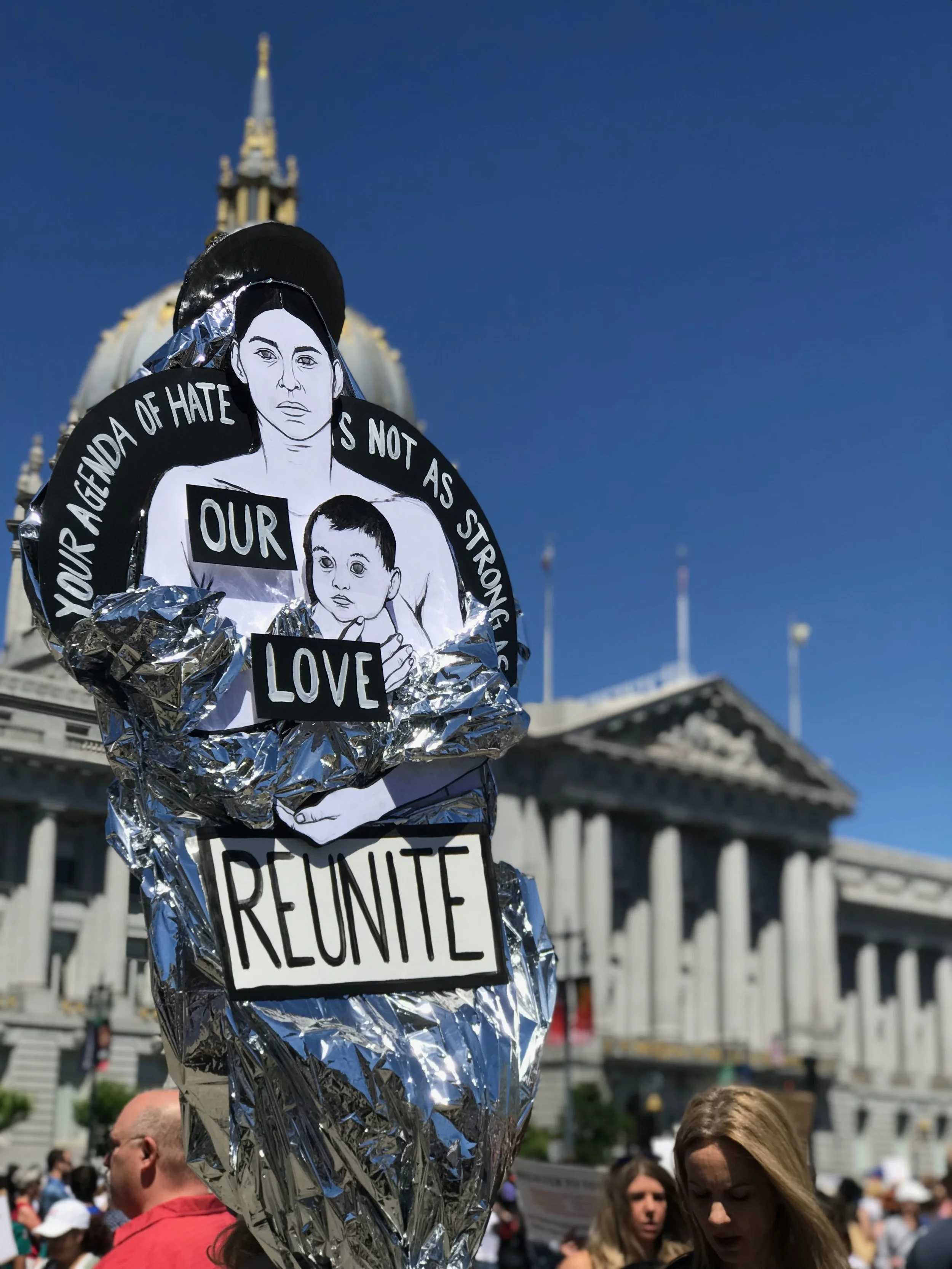
On a beautiful Saturday morning in San Francisco we marched.  June 30, 2018.

Young, old, families, babies in backpacks, dogs, and sign after sign which cried out:  together we stand ... for the families, for this country and its ideals, for immigrants of all colors and sizes...  There was chanting and drums and trumpets, and cops walking along beside on as we walked.  At the end of our march we gathered at City Hall and listened to music, we sang with Joan Baez and listened to her explain that now is the time for peaceful disobedience.  She has been there, god knows, and she sees that when the divison is so severe, the prejudice so cruel, the only thing that will move the immovable is disobedience.  Peaceful disobedience.

I felt proud of being part of this city, this community, even this country, in that moment, and for a while I believed.  That change will come.  The Buddha teaches us that change is a permanent piece of our experience, and that often change is painful.  He called it "dukkha."  And that even though we all suffer in this life, that doesn't mean we cannot hope for/believe in change:  for people to be treated equally and humanely, for education for our children, health care, the end of nuclear warfare, the nurturing of our wounded planet, and so on ...  

There's an aching place in my heart these days despite my trust in change.  The society I (we) inhabit is currently filled with hostility and mistrust and fear.  And YET, we must march on - together - we must speak out - together, we must stand up for our values - together.    My faith in the young helps me keep on going, I believe in their intense investment in this country and their own future.    My deepest wish is that all my grandchildren will join this society, register to vote, and speak out honestly, no matter how hard that is.  They are part of this vast unfolding future.

I, along with my fellow baby boomers, are seeing the path ahead become shorter and shorter.  We feel the urgency of change and bringing the world together...  So, it is up to the young tribes in our midst to manifest what is right and true;  we are a community of beings who desperately need each other and who have the power to change our conditions and lead good lives.

Together!


Mag Dimond